EJNProjects - Project Portfolio
ACADEMIC PROJECT - UNIVERSITY LEVEL (BEng Hons Mechanical Engineering) (COMPLETE)
An Honours project undertaken at the University of Plymouth as part of a BEng (Hons) Mechanical Engineering degree with UKAS Accredited mechanical testing company, Metaltest UK.
The aims and objectives of this project were as follows:
► To investigate and identify the difference in TEA, UCL, SEA and failure mechanism of specimen samples manufactured to represent the space frame of a real vehicle. These characteristics will be examined on tubular structures in their bare form and of the same type that has undergone a composite reinforcement process.
► Utilise hand calculations done in accordance with ISO 80000 (ISO 80000-1:2009 Quantities and units — Part 1: General, 2009) and FEA software to design and manufacture specimen samples representing tubular components of a vehicle space frame constructed with and without a composite reinforcement technique.
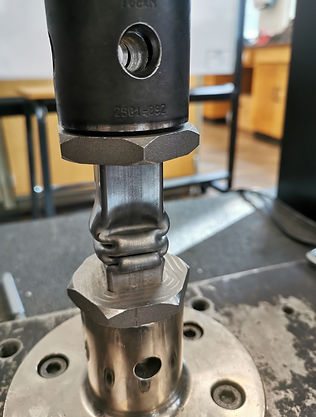
► Perform axial quasi static compression testing on samples and analyse energy TEA, SEA and UCL, using testing guidelines from peer reviewed sources.
► Carry out a comparison of data derived from testing unreinforced and reinforced samples to highlight any improvement in crashworthiness performance.
► Perform visual inspection and analysis of tested samples to investigate failure modes.
Achievements of project
The composite cladding process that was developed as part of this project increased the specific energy absorbency of structural elements of a space frame by up to 700%, providing a very substantial increase in crashworthiness. Due to this project being extremely successful from an academic standpoint, it has been shortlisted for publication in the Plymouth University Student Scientist Journal. Further research into the field of crashworniness is planned for a future project, either academically or as home based research.
Milestones and highlights of project
Choice of project
The inspiration of my project stemmed from my enthusiasm for motorsport and aerospace engineering, space frames are used extensively in both fields on engineering and a project that encompassed both of these would keep me motivated throughout. For this project I chose to heavily involve a composites element, my degree programme did not include the composites module so I chose to optionally study it alongside my degree to gain deeper understanding of another aspect of engineering. Safety is also extremely important within engineering, so a project that was centered around improvement of safety would prove to be very useful. All of these factors play a part in determining the project I was going to undertake, which ended up being a study into improving the crashworhiness of space frame based vehicles using composites, a project that held real relevance in the modern world of engineering.
Literature review
An in depth literature review was first conducted to get an idea of prior and current research on chosen project, literature that proved to be the most useful was generally from projects undertaken in the aerospace industry in the field of energy absorbers. These journals tended to describe a range of test methods, which was useful due to a standardised ASTM test procedure for axial compression of tubular structures not existing.